Beyond Security — What Money Is Really For
Stages 4 and 5 aren't about accumulation. They're about meaning — and what continues after you.
Tauna Esslinger
4/28/20264 min read

Most of the work I do with clients happens in Stages 1 through 3. Getting clear. Building stability. Securing the future. That's where the heavy lifting is — and for most people that's where they spend the majority of their financial journey.
But even with my clients in those early stages, I can see glimpses of the vision of the last two stages starting to develop.
Two examples come to mind;
One, a client in Stage 1 works two jobs as a single mom to make ends meet, but not just for that, because she dreams of giving her children more. Not just opportunities like college, but also the values and beliefs around a sustainable future for them and their children. That’s a Stage 5 consideration.
Another client in Stage 3 started to feel secure in their finances, and was finally able to look up from their own situation and saw the needs around them and thought…”maybe soon I can be the one to help.” That’s what Stage 4 is about.
Those glimpses are what the final two stages are about — and they're exactly what the hard work of Stages 1 through 3 is building toward
____________________________________________________
The Five Financial Life Stages — A Quick Reminder
Stage 1 — Lay the Foundation: Get clear, create order, stop the bleed
Stage 2 — Create Stability: Build safety, buffers, and breathing room
Stage 3 — Secure the Future: Plan for retirement and life beyond today
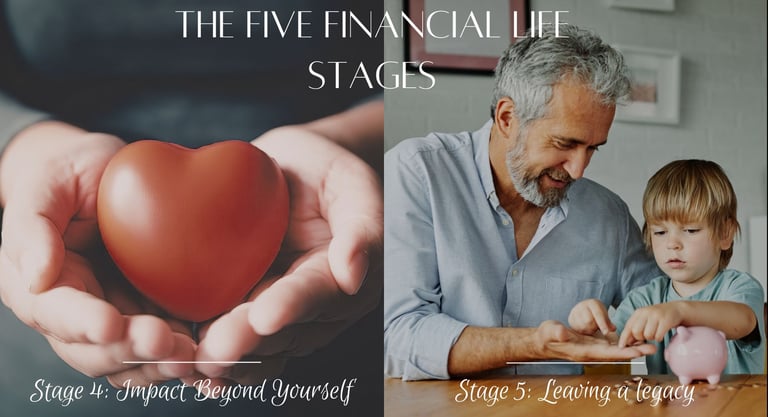
Stage 4 — Impact: Use money on purpose, beyond yourself
Stage 5 — Legacy: Establish what will continue after you
____________________________________________________
Key Concepts
The Problem: It's hard to see beyond the stress and struggles of today — and even harder to imagine a season where your money could make a wider impact or leave a meaningful legacy.
The Solution: Stages 4 and 5 aren't as far away as they feel. Every intentional step taken in Stages 1 through 3 is quietly building toward a season where money becomes a tool for something beyond survival — for meaning, for generosity, for what continues after you.
The Core Message: The goal was never just to be financially secure. It was to build a life — and a legacy — that reflects what you actually value. Security is the foundation. This is what you build on top of it.
____________________________________________________
A Closer Look: Stage 4 — Impact
Stage 4 is about overflow.
Not overflow in the sense of excess — but in the sense of a cup so carefully and consistently filled that it simply can't help but spill over into the lives of others.
What I've noticed is that Stage 4 often begins not with a plan, but with a feeling. Giving shifts from obligation to expression — of gratitude, of freedom, of what someone actually believes about money and generosity. It's less about the amount and more about the intention.
I want to be clear about something here: generosity is present in every stage. For many of my clients, tithing — giving ten percent of their income to their church or a cause they believe in — is a value they hold from the very beginning regardless of where they are financially. Tithing doesn't wait for Stage 4.
What Stage 4 adds is the capacity to go further. What I've observed is that giving above the tithe — being able to consistently give truly generous contributions beyond that ten percent — can only feel sustainable and joyful after the first three stages are solid. When the debt is gone, the emergency fund is real, retirement is being funded. That's when the margin exists not just to give ten percent and to do it from a place of genuine overflow.
Stage 4 isn't only about financial giving. It's also about time and talent — the freedom to show up consistently for the organizations you love, to serve and volunteer without the financial pressure that once made that feel impossible.
The organizations and causes that call to you — your faith community, a local nonprofit, a cause close to your heart — these are the places where Stage 4 comes alive.
____________________________________________________
A Note on the Distinction Between Stage 4 and Stage 5
The simplest way I know to explain the difference:
Stage 4 is impact now — you present, alive, directing your time and resources toward what you love and getting to see the results.
Stage 5 is impact after — what continues when you're no longer here to direct it.
____________________________________________________
A Closer Look: Stage 5 — Legacy
Legacy is perhaps the most intentional thing a person can build — and the most quietly powerful.
What I've noticed is that Stage 5 isn't really about death. It's about continuation. It's about asking — while you're still here, while you still can — what do I want to keep going after I'm gone?
For the people you love, that means making sure they're cared for — not just financially, but in knowing what you valued and what you believed. The practical planning matters here. And what I've observed is that the people who have done this work carry a quiet peace that has nothing to do with the documents themselves — it comes from having said clearly: here is what I built, here is who I love, and here is what mattered to me.
For the organizations and causes you've supported, Stage 5 asks a simple question: how do I make sure they don't lose me as a benefactor when I'm gone?
And perhaps most beautifully — legacy is the values you leave behind. The intentionality modeled in every stage. The way you handled money — with clarity, generosity, and purpose — living on through the people who watched you do it.
Legacy isn't something that happens after you die. It's something you construct — one intentional decision at a time — while you still have the chance.
____________________________________________________
What To Do Next
You don't need to be in Stage 4 or Stage 5 to take these steps. Earlier is always better.
1. Identify one organization you want to support. It doesn't have to be now and it doesn't have to be large. Just write it down. That's the beginning of your impact plan.
2. Get your practical planning in order. A will. Life insurance. Beneficiary designations that reflect your current life. What I've observed is that the people who have done this work carry a quiet confidence that comes from knowing the people and causes they love are taken care of.
That's your next right step.
And if you're not sure where you are in the Five Financial Life Stages — or how to start building toward the life and legacy you actually want — that's exactly the kind of conversation a free strategy session is for.